on 20 DEC, 2021
What was our Research Objective?
When this topic is being brought up, in most cases, it is being discussed in the big picture. We decided to focus on one significant aspect of the environmental problem that can be changed not by institutions or international companies but by individuals. Plastic, a material that we utilize for everything and contaminates our environment, is maybe the foremost destructive of junk sailors and sea-goers in the ocean since it does not promptly break down in nature. The plastic that goes over the side nowadays may still be around in hundreds of a long to foul up future generations' angling adapt, watercraft propellers, and shorelines. Careless transfer of plastic can have desperate results. They additionally destroy ecosystems, although they are invisible to the naked eye. The average decomposition time for plastic products created using different technologies ranges from 400 to 700 years. Plastic bags, used by people daily, decompose in nature from 100 to 200 years. This is the flip side of the strength and durability of plastic products. In this case, a glass bottle can decompose for up to 1 million years (Fok, 2016). The main concerns are related to the fact that plastics, when released into the ground, break down into small particles and may release chemicals added to them during production into the environment. It can be chlorine, various chemicals, such as toxic or carcinogenic anti-flames. These chemicals can seep into groundwater or other nearby water sources, which can cause serious harm to those who drink this water. In addition, as it decomposes, the so-called biodegradable plastic can release methane, a potent greenhouse gas that makes a significant contribution to global warming. Plastic does not pose any potential threat when entering landfills since the dump is a remarkable engineering structure created to protect the environment and human health and prevent pollution, including soil and groundwater (Fok, 2016). Most of the harm is caused by the same plastic that the person throws out in the unintended places or ends up in spontaneous landfills.
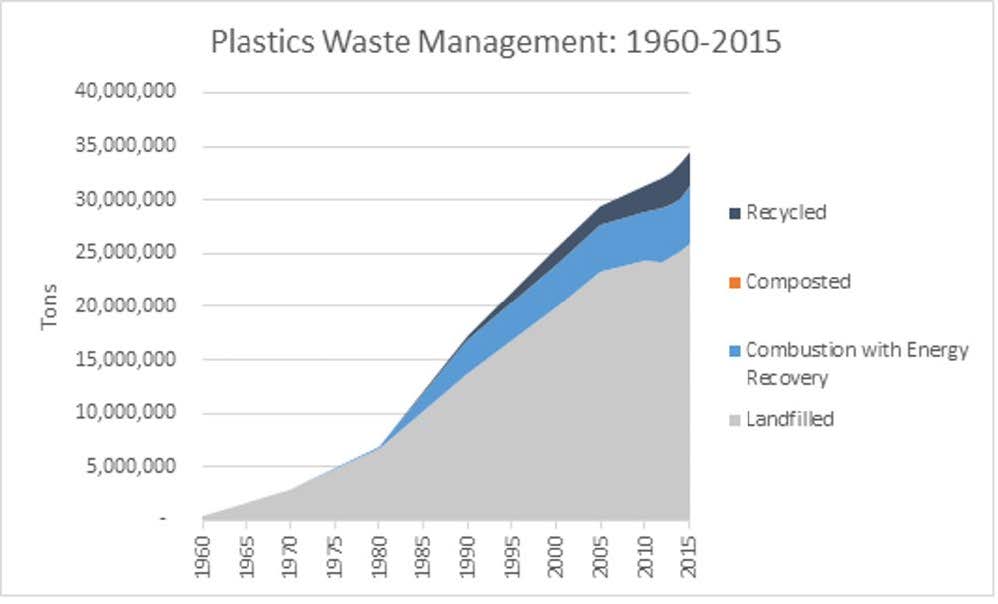
The graph above shows that despite the time it takes for plastic products to decompose, most of those products are thrown into a landfill. Despite the growth of recycling, the number of wastes is still myriad. The Pacific Institute shows that the intermediate portion of the total plastics output that packaging takes up is about 35 to 45 percent, and 14 percent goes to plastic bottles. We decided to focus our efforts on something that is everywhere but always left neglected: Plastic bottles. Instead of recycling every plastic bottle, reducing the number we use will be easier. To achieve this, we have to influence people, show them alternatives, and motivate them to change. In the past, to influence someone, people had to write articles, make speeches on the street, or prove their point on national television. However, our modern world gives us a more manageable and much more efficient way of achieving it: Social media. Is it possible to influence people to get rid of plastic bottles and use an alternative? We think that the answer is yes, we can. The main factor is promotion and motivation. Brands are using the power of social media promotion. 73% of marketers accept that their endeavors through social media showcasing have been “somewhat effective” or “very effective” for their trade. Many brands are applying social media in their showcasing methodology for all the right reasons (Buffer, 2019). Whether it’s influencer showcasing or story advertisements, they’re attempting it all. Social media permits brands to get to cost-effective showcasing, connect with their gathering of people, and construct brand dependability. It is clear that social media's influence on people is significant, so we consider that we can bring more attention to this problem by utilizing them. One more factor is motivation; how will we motivate people to execute the actions? We decided to use the same tactics used by sports teams: Competition. It is common to observe how sports fans of particular teams cooperate to win against their competitors. It can be done through the number of likes, reposts, or hashtags. Their teams' rivalry motivates people, so it is possible to utilize this motivation in the right way. However, in the beginning, for research purposes, our campaign will focus on competition between the universities (Marbella International University Center, 2021).
Due to the current circumstances and the quarantine, our lifestyle has changed a lot, and people tried to minimize physical contact with each other. As a result, the online shopping industry began to develop tremendously, and food delivery is also entering the industry. Unfortunately, many consumers started to order food at home more often. This trend contributes to the growth in the number of plastic packaging. It also affected our cafeteria. The university administration decided to distribute food in packages to eat in their rooms without being exposed to danger. Looking back from now, this was a timely and correct decision. And this opportunity is still present. Unfortunately, these bags endanger the environment, as described above. Plastic bags and containers make up the most considerable portion of plastic contamination. In addition to the packages intended for food, the kit also includes a plastic fork, knife, and spoon. In the end, of course, where a massive amount of garbage is formed, that isn't easy to recycle. Plastic bags are everywhere today. They are packed with products in stores and supermarkets, and people also use them in everyday life. Mountains of garbage from plastic bags have filled cities: they stick out of trash bins and roll on the roads, swim in water bodies, and even catch on trees. Everything drowns in these products from the world of polyethylene. It may be convenient for people to use plastic bags, but few people think that using these products ruins our nature. Plastic bags are in great demand, as they are convenient to use for storing any product. Plus they are cheap. However, they do great harm to the environment. It's time to abandon them because there are many valuable and functional alternatives in the world. Come to the store to shop with a used bag or eco-bag, as is customary in many countries worldwide. Environmentalists actively oppose the use of plastic bags. Today, in many countries, polyethylene products are limited, and in some, it is prohibited. Denmark, Germany, Ireland, the USA, Tanzania, Australia, England, Latvia, Finland, China, Italy, India are among the countries that are fighting with packages.